Structural and Functional Characteristics of Eubacteria
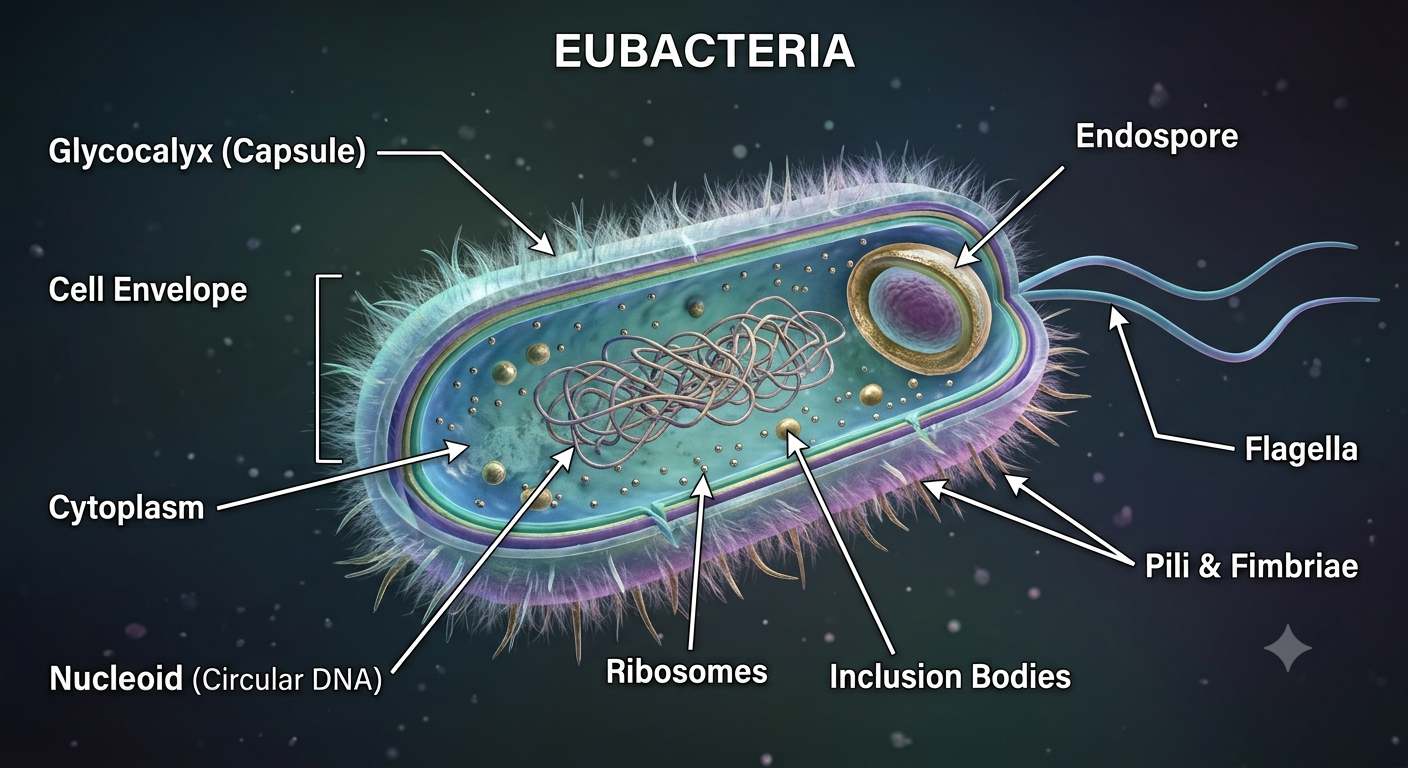
Eubacteria represent a diverse group of single-celled prokaryotes characterized by specific biochemical markers, most notably the presence of peptidoglycan in their cell walls and ester-linked unbranched fatty acid chains in their membrane lipids. Their survival and pathogenicity are dictated by complex cellular architectures, including specialized cell envelopes (Gram-positive vs. Gram-negative), various surface appendages for motility and adhesion, and the ability to form highly resilient endospores. Understanding these structural components is fundamental to environmental microbiology, as they dictate how bacteria interact with their surroundings, resist environmental stressors, and transfer genetic material.
Core Biological Composition
Eubacteria are defined by a distinct set of biochemical and structural features that differentiate them from other domains of life:
Cellular Nature: They are strictly single-celled prokaryotic organisms.
Cell Wall Chemistry: Possession of peptidoglycan is a defining trait of the eubacterial cell wall.
Membrane Lipids: Their membrane lipids consist of unbranched fatty acid chains linked to glycerol through ester bonds.
Cytoplasmic Organization: The cytoplasm is a dense gel containing:
Nucleoid Region: Where the bacterial chromosome is coiled.
Ribosomes: Specifically of the 70S variety.
Inclusion Bodies: Utilized for nutrient storage, such as poly-beta-hydroxybutyrate or polyphosphate.
Enzymes: Various dissolved enzymes necessary for cellular metabolism.
The Cell Envelope: Comparative Architecture
The cell envelope provides structural integrity and serves as a primary interface with the environment. Eubacteria are generally categorized based on the composition of this envelope.
Table 1. Comparative Architecture of Eubacteria
Feature | Gram-Positive Bacteria | Gram-Negative Bacteria |
|---|---|---|
Peptidoglycan Layer | Thick Layer | Thin Layer |
Teichoic Acid | Present and Abundant | Absent |
Outer Membrane | Absent | Present |
Lipopolysaccharides (LPS) | Absent | Present in the outer membrane; act as endotoxins |
Surface Structures and Appendages
Bacteria utilize a variety of external structures for protection, environmental interaction, and movement.
Glycocalyx
The glycocalyx is an outer viscous layer composed of polysaccharides or polypeptides. Its function depends on its physical organization:
Capsule: A tightly bound layer that protects the cell from phagocytosis.
Slime Layer: A loose and diffuse layer that facilitates surface attachment and the development of biofilms.
Proteinaceous Appendages
These specialized structures extend from the cell surface to perform mechanical and genetic functions:
Flagella: Act as rotary motors to provide motility.
Fimbriae: Short, abundant, bristle-like structures used for adhering to surfaces.
Pili: Longer appendages that facilitate "twitching motility" and are essential for horizontal gene transfer through the process of conjugation.
Survival Mechanisms: Endospores
Certain genera, most notably Bacillus and Clostridium, possess the ability to enter a state of dormancy through the production of endospores.
Trigger: Endospore formation is initiated by nutrient depletion.
Resilience: Endospores are highly resistant to extreme conditions that would typically prove lethal to vegetative cells, including:
Extreme heat
Ultraviolet (UV) radiation
Desiccation (drying out)
Chemical disinfectants
Chemical Basis for Resistance: Their extreme durability is attributed to the presence of dipicolinic acid complexed within the spore structure.