Structural Innovations of Archaea
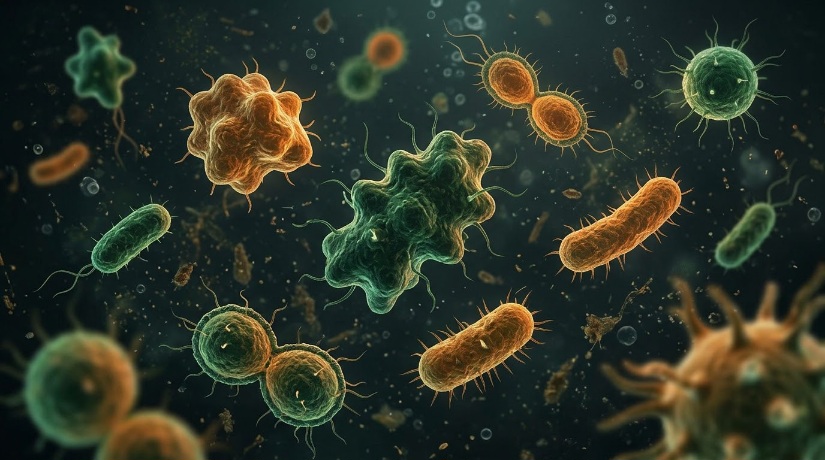
Archaea constitute one of the three main domains of life (alongside Bacteria and Eukarya). Though they resemble bacteria under a microscope, their biochemistry, molecular biology, and evolutionary lineage make them vastly different.
1. Structural Innovations
Ether-Linked Lipids & Monolayers
Ether vs. Ester Linkages: Bacteria and eukaryotes link fatty acids to glycerol using ester bonds. Archaea use ether bonds, which are chemically far more resistant to heat, acid, and hydrolysis.
Isoprenoid Chains: Instead of unbranched fatty acid chains, archaeal lipids consist of repeating 5-carbon isoprenoid units (branched hydrocarbon chains).
Lipid Monolayers: In extreme hyperthermophiles, the lipid tails fuse across the membrane to form a single continuous molecule (tetraether monolayer). Unlike a standard lipid bilayer that peels apart at high temperatures, a monolayer cannot easily melt or split.
Peptidoglycan-Free Cell Walls
No Peptidoglycan: Archaea lack real peptidoglycan, making them naturally immune to antibiotics like penicillin that target bacterial cell wall synthesis.
Pseudomurein: Some archaea use pseudomurein, which replaces bacterial N-acetylmuramic acid with N-acetyltalosaminuronic acid and features$\beta(1 \rightarrow 3)$glycosidic linkages instead of $\beta(1 \rightarrow 4)$.
S-Layers: Many archaea possess a simple cell wall consisting solely of a surface layer (S-layer) made of interlocking protein or glycoprotein subunits anchored directly to the cell membrane.
2. Eukaryote-Like Genetic Machinery
Despite having a circular chromosome without a nucleus (like bacteria), Archaea process genetic information using mechanisms closely aligned with eukaryotes:
Process | Archaea | Bacteria | Eukaryotes |
|---|---|---|---|
RNA Polymerase | Single complex enzyme (10–13 subunits), closely resembling Pol II | Simple enzyme (4–5 subunits) | Three complex enzymes (Pol I, II, III; 10–12+ subunits) |
Transcription Factors | Uses TATA-binding protein (TBP) and TFIIB homologs | Uses (sigma) factors | Uses TBP, TFIIB, and complex initiation factors |
Translation Start | Initiated with Methionine | Initiated with N-formylmethionine | Initiated with Methionine |
DNA Packaging | Histone-like proteins wind DNA into nucleosomes | DNA-binding proteins (no true histones) | Core histones form octameric nucleosomes |
3. Habitats & Ecological Roles
Extreme Environments (Extremophiles)
Hyperthermophiles: Live in environments above 80°C (e.g., Pyrococcus furiosus near hydrothermal vents), using heat-stable enzymes like Pfu polymerase.
Halophiles: Thrive in saturated salt solutions (>15–20% NaCl, e.g., Halobacterium salinarum) by maintaining high internal KCl levels and producing bacteriorhodopsin to generate energy from light.
Acidophiles: Flourish at pH values below 2.0 (e.g., Sulfolobus in sulfur springs) by actively pumping protons out of the cell.
Methanogenesis & Carbon Cycle
Methanogens are obligate anaerobes that convert simple organic compounds or gases into methane $\text{CH}_4$. They play an irreplaceable role in global biogeochemistry:
$$\text{CO}_2 + 4\text{H}_2 \rightarrow \text{CH}_4 + 2\text{H}_2\text{O}$$
Wetlands & Anoxic Sediments: Responsible for natural atmospheric methane emissions.
Ruminant Digestion: Symbiotic methanogens in cattle and sheep stomachs degrade plant fibers, producing methane as a byproduct.
Wastewater Processing: Used in anaerobic digesters to break down organic sludge and produce biogas $\text{CH}_4$.