What Defines a Fungus?
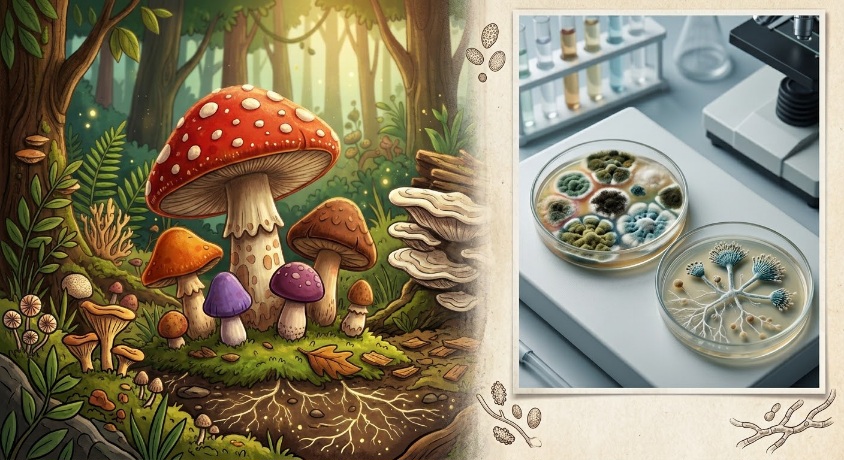
Fungi are one of the most diverse and essential kingdoms of life on Earth.
1. What Defines a Fungus?
Unlike plants, fungi do not contain chlorophyll and cannot perform photosynthesis. Instead, they are heterotrophs specifically absorptive heterotrophs.
Extracellular Digestion: Rather than taking in food like animals do, fungi secrete powerful digestive enzymes directly onto their organic surroundings. These enzymes break down complex polymers (like proteins, fats, and tough plant fibers) into simpler molecules, which the fungal cells then absorb across their cell walls.
Storage: Fungi store excess energy as glycogen, the same carbohydrate storage molecule used by animals, rather than starch (which plants use).
2. Structure & Growth Structural Components
Chitin Cell Wall: Unlike plant cell walls made of cellulose or bacterial cell walls made of peptidoglycan, fungal cell walls are reinforced with chitin—the same tough polysaccharide found in the exoskeletons of insects and crustaceans—along with glucans.
Hyphae: Multicellular fungi grow as micro-filaments called hyphae. Hyphae grow from their tips and branch out rapidly, allowing the fungus to explore and invade new food sources.
Mycelium: A mass or web of interconnected hyphae forms a mycelium. While the mushroom you see above ground is a temporary reproductive organ (fruiting body), the bulk of the organism lives underground or inside decaying wood as an extensive mycelial network.
Body Forms
Unicellular (Yeasts): Single-celled fungi that typically reproduce by budding or binary fission.
Multicellular (Molds and Mushrooms): Filamentous fungi that form complex mycelial structures.
Dimorphic Fungi: Certain fungi can switch between a single-celled yeast form and a multicellular hyphal form depending on environmental factors like temperature or nutrient availability (e.g., Candida albicans).
3. Ecological &Biological Importance
Saprophytic Decomposition & Nutrient Cycling
Fungi are among the few organisms capable of breaking down lignin and cellulose—the tough structural compounds that make wood and plant matter rigid. Without fungal decomposition, dead plant tissue would accumulate, locking up essential elements like carbon, nitrogen, and phosphorus away from the rest of the biosphere.
Symbiotic Relationships
Mycorrhizae: A mutualistic partnership between fungi and plant roots. The fungus extends the reach of the root system to absorb water and mineral nutrients (especially phosphorus) from the soil, while the plant provides the fungus with photosynthetic sugars. Over 80–90% of land plants rely on mycorrhizal associations.
Lichens: A symbiotic association between a fungus (usually an Ascomycete) and a photosynthetic partner (green algae or cyanobacteria). Lichens can colonize extreme habitats like bare rock or arctic tundra.
Pathogens & Parasites
Plant Pathogens: Fungi cause diseases such as Dutch elm disease, corn smut, cereal rusts, and powdery mildew, impacting agricultural yields globally.
Animal & Human Pathogens: Fungal infections (mycoses) range from superficial conditions (e.g., ringworm, athlete's foot, thrush) to life-threatening systemic infections in immunocompromised individuals (e.g., aspergillosis, cryptococcal meningitis).
Fungi matter to environmental health engineering for two main reasons:
As a hazard to control: Engineered ventilation and filtration systems are needed to remove their resilient spores from indoor air.
As a tool to use: Their specialized digestive enzymes and root-network behaviors can be harnessed to treat tough industrial waste, capture nutrients, and clean up contaminated environments.