Bacterial growth in a batch system
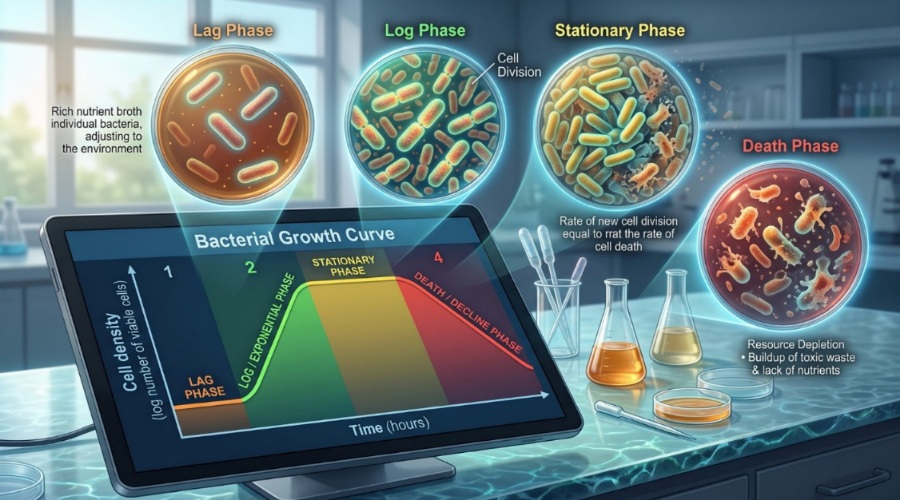
Bacterial growth in a batch system follows a predictable pattern driven by available food and living space. A batch system is a closed environment, like a sealed flask or a isolated body of water, where bacteria are placed with a fixed amount of nutrients. No new food is added, and no waste products are removed.
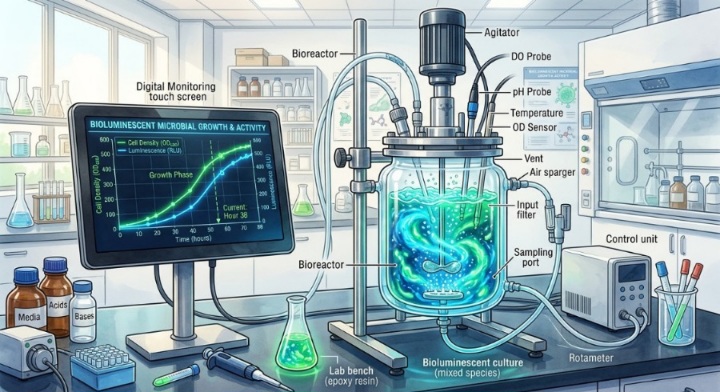
Over time, as the bacteria consume nutrients and produce waste, their population transitions through four main phases.
The Four Growth Phases
1. Lag Phase (Adaptation Period)
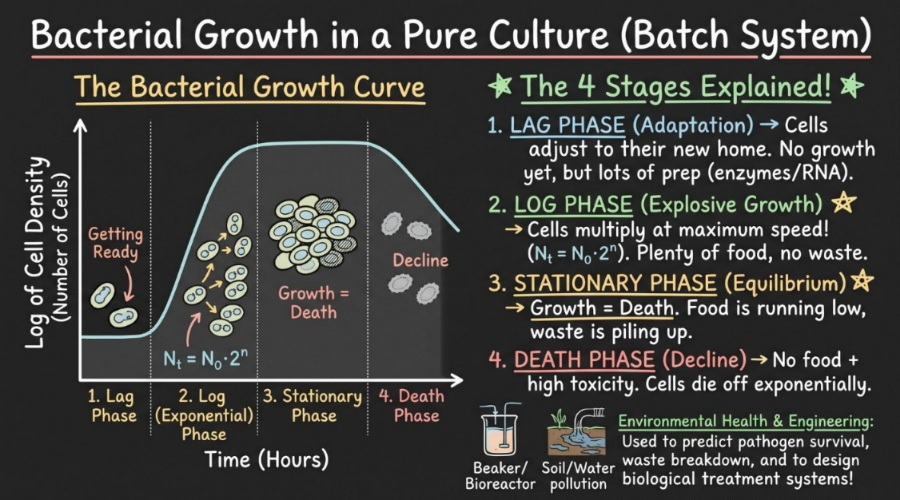
When bacteria are first placed into a new environment, they do not multiply immediately.
What happens: The total cell count stays constant, but the cells are very active internally.
Why it occurs: The bacteria must adapt to their new home. They spend this time building necessary cellular tools, such as enzymes and proteins, and absorbing available nutrients to prepare for multiplication.
2. Exponential or Log Phase (Rapid Growth)
Once adapted, the bacteria begin multiplying at their maximum possible rate.
What happens: Cells reproduce by dividing in half (binary fission). The population doubles at regular intervals, leading to explosive, exponential growth ($N_t = N_0 \cdot 2^n$).
Why it occurs: Nutrients are plentiful, toxic waste is still low, and environmental conditions are ideal for life.
3. Stationary Phase (The Plateau)
Eventually, the closed system reaches its limits.
What happens: The population size stabilizes and stops growing. The number of new bacteria being born equals the number of bacteria dying.
Why it occurs: Food sources are running low, space is limited, and metabolic waste products accumulate, creating a stressful environment.
4. Death Phase (Population Decline)
If left in the closed system without intervention, the environment becomes hostile.
What happens: The cell death rate exceeds the birth rate, causing the total number of living bacteria to decline exponentially.
Why it occurs: Severe food exhaustion combined with high levels of toxic waste leads to widespread cell death.
Practical Applications in Environmental Health
Understanding these growth dynamics is essential for environmental health engineers and researchers who manage or monitor biological systems:
Bioreactors and Waste Treatment: Engineers designing localized waste treatment systems or soil cleanup operations rely on batch kinetics to calculate how much nutrient "food" to add and when to harvest or refresh the system to keep beneficial bacteria in their peak growth (Log) phase.
Water Safety and Pollution Tracking: When an accidental chemical or biological spill occurs in a lake or river, researchers use these growth stages to predict how fast harmful pathogens might multiply or how quickly indigenous bacteria can break down toxins.
Predicting Survival Rates: Knowing these baseline kinetics helps scientists model the natural die-off rates of both helpful microbes and dangerous bacteria under various environmental stress factors.